The experience behind the work
My work is shaped by lived experience, twenty years in demanding professional environments, and an academic interest in why people so often struggle to access the help they need.
Why I do this work
In 2016, my partner died by suicide. He was twenty-eight, and had been living with bipolar disorder, alongside problems with substance use. I had supported him through the diagnosis and through the period before his death.
That death was the most defining moment of my life, and the catalyst for everything that followed. In supporting him, I gained a close and painful view of the gaps that can exist around mental health and addiction support, and of how the two compound each other in ways that separate services can struggle to address together. And something harder to name: an understanding of what it is to love someone through the most difficult period of their life, to be present for the worst of it, and to lose them anyway.
In the period that followed, I collaborated with Peter Stanford on an article for The Independent about my partner’s life. Writing it was the beginning of a reckoning I had not anticipated. It asked me to think clearly about the systems that had surrounded him, and hadn’t. About what the clinical and institutional world could and couldn’t provide. About race, about mental illness, about the specific ways people fall through the gaps between categories. About what I wanted to do about any of it.
I also know what it is to be struggling deeply while appearing completely functional. Nobody knew. I went to rehab in 2017. I mention it because it is the most important fact about why I do this work, and leaving it out would make everything else dishonest. I know what it is to sit in a treatment centre and feel the crushing realisation that the cat is out of the bag. The fear of the blood tests. The dread of the group therapy room. The strange grief of leaving a protected environment you have come to depend on. The terror of the journey home, and what ordinary life is going to look like now.
I have worked my recovery since then, across high-pressure professional environments, international travel, personal loss, and every social situation that was supposed to make it impossible. I don’t put that down to anything exceptional in me. The right support made the difference.
Studying at Cambridge during my own recovery
His death was the beginning of my determination to understand, properly and rigorously, why the support structures that should have been there were not. I entered Cambridge in 2019, in the middle of my recovery, to read Human, Social and Political Sciences: how institutions work, and how societies fail the people they claim to serve. I chose it because those questions were not abstract to me. They were the questions my life had already asked.
My research examined one of them directly: why the people who most need support are so often furthest from the services built to reach them, and how exclusion, even inside the very spaces designed to help, pushes people beyond the reach of care. Its conclusion became the conviction this practice now rests on: help that exists is not the same as help that arrives. Support has to meet people where they actually are.
Cambridge gave me something beyond the degree. I was thirty-six, in recovery, surrounded by peers half my age encountering serious pressure for the first time. I was the college LGBTQ+ officer, sitting with people in the specific confusion and intensity of early adulthood, at 3am in a college corridor, in the week before exams. I was not the one with the answers. I was the one who had lived enough to sit with them in the question.
That experience settled it. It confirmed what the grief and the recovery had already told me: that the work I needed to do was not in policy or the civil service. It was in this work, supporting people in their everyday lives.
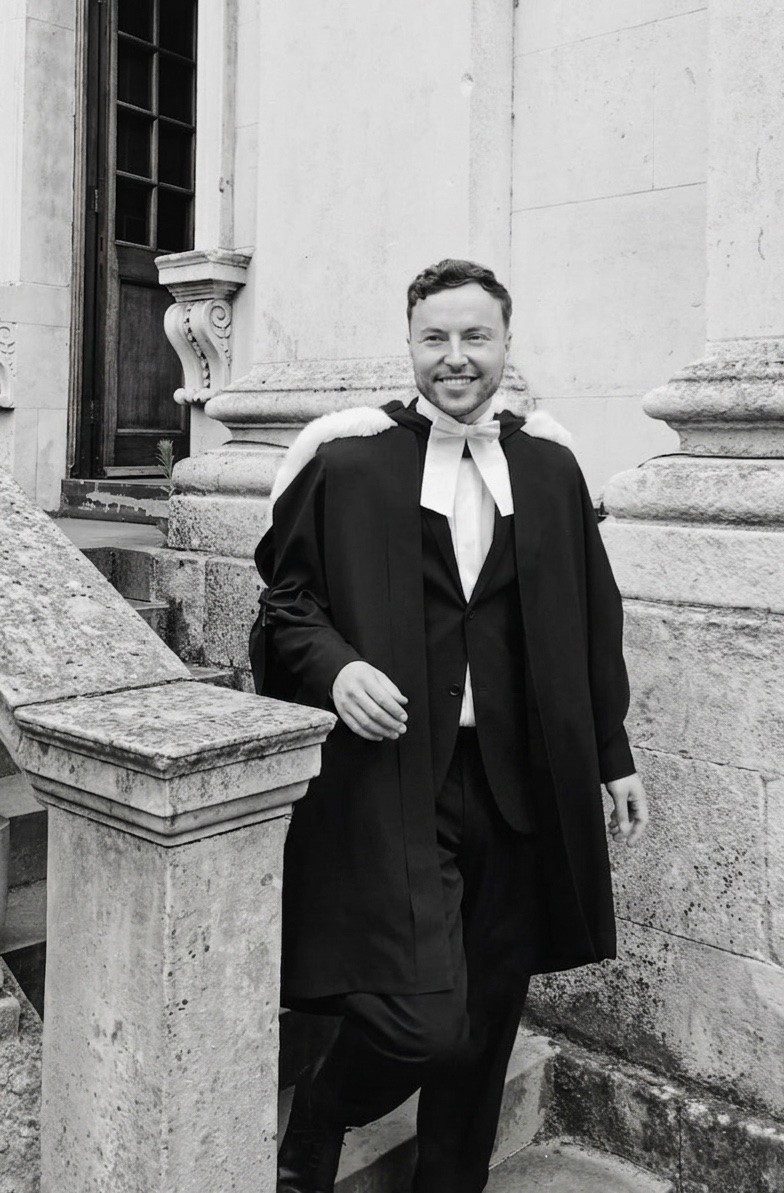
I graduated in 2022 with a First. I mention it because it shows what the right conditions and support can make possible.
Before this work
Before this practice, I spent twenty years in the creative industries, much of it managing people and logistics under pressure: large events, travel across countries and time zones, teams, schedules and clients who needed things to go right, often in private settings where discretion was assumed.
It turns out to be useful here. Bringing someone home from treatment abroad, planning a week of live-in support or keeping a family, a clinic and a flight schedule in step uses the same skills: thinking ahead, holding several moving parts at once, and staying calm when something changes at the last minute.
What working with me looks like
The engagements have varied widely. A difficult journey home from treatment. A young adult finding their feet at university. Someone in London in early recovery who found this site at an unusual hour and reached out anyway. A family who didn’t know where to start. The setting and the person change, but the work starts in the same place.
Often the first call isn’t from the person who is struggling. It’s from a parent, a partner or a sibling who has been carrying the worry for a long time. I usually start with them: what is happening, what is realistic, and what they can stop carrying. Sometimes that leads to work with the person they’re worried about. Sometimes the most useful work stays with the family.
I pay close attention. To what someone says they want, what they repeatedly do, where those two things diverge, and what may be sitting underneath the behaviour. I will reflect that back plainly. Sometimes gently. Sometimes very directly.
In practice the work comes down to three things. The first is noticing the pattern: what sets it off, what keeps it going, and the point where a different choice was still available. The second is doing the hard part alongside someone before stepping back: the first dinner out, the phone call put off for a month, the walk into the meeting, the party or the gym. Doing something once with someone beside you makes the second time far easier. The third is the practical structure that so often goes first, the planning, starting, finishing and keeping track of time that holds a week together. People tend to treat that as a failure of willpower, when it is usually something that can be rebuilt with the right support.
Addiction taught me that the visible behaviour is rarely the whole story. People can know exactly what is damaging them and continue doing it. They can be intelligent, loved, successful, frightened, exhausted and completely sincere in wanting things to change, and still find themselves back in the same place. I was one of them.
That contradiction is why I work the way I do. I try to be compassionate without being vague, and direct without making anyone feel small. Some people need structure; others need room. I bring lived experience, perspective and practical judgement where they are useful, but the work remains centred on the person in front of me. Lived experience can shorten the distance between two people, but it doesn’t make the work about me.
Professional standards and accountability
If you’d like to talk, I answer this number myself.
The first conversation is free, with no obligation. I reply the same day, every time.
Message on WhatsApp Call +44 7448 710827 Confidential enquiry by email